Madrid Trip
Pass
Plaza Mayor, Madrid

Plaza Mayor: Madrid's Grand Central Square

A vast 17th-century public square at the heart of Madrid's Centro neighborhood, Plaza Mayor has served as the city's main stage for markets, royal ceremonies, and daily life for over 400 years. Entry is free, any time of day.

Square Centro
Plaza Mayor Centro Always open
Construction began in 1580 under Philip II and was completed in 1619 during the reign of Philip III — making Plaza Mayor one of the oldest continuously used public spaces in Spain. The square stands as the geographical and historical anchor of Old Madrid, a place where royal proclamations once echoed off stone arcades and crowds gathered for events that shaped the city's identity over four centuries.

The plaza sits squarely in the Centro neighborhood, just a few blocks from another of Madrid's celebrated squares, the Puerta del Sol. That proximity makes it easy to combine both in a single leisurely walk through the old city core, giving you a clear sense of how Madrid's historic street network radiates outward from these two focal points.

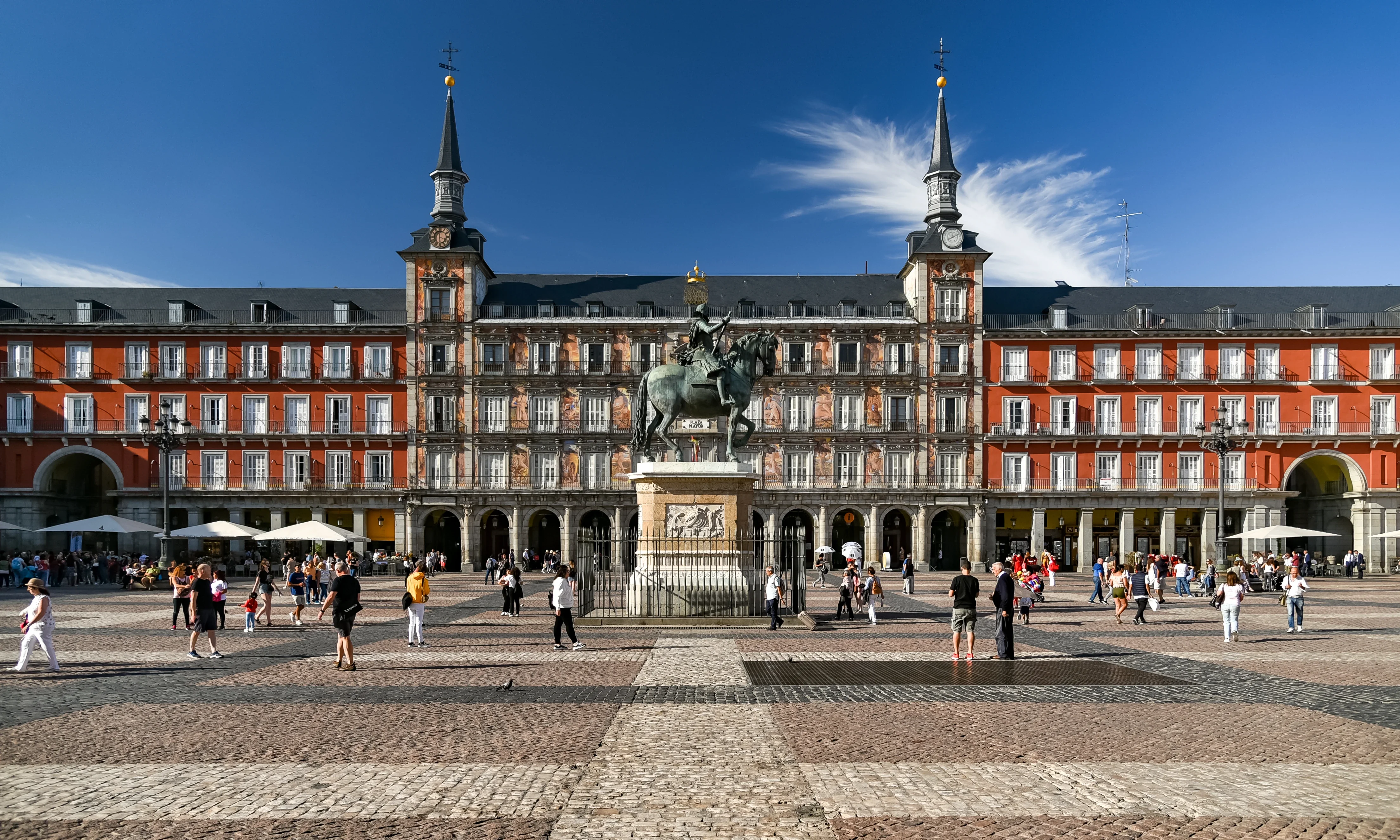
Today the rectangular square is framed by uniform colonnaded buildings whose ground floors host cafés, restaurants, and shops beneath the arches. The open central area fills with visitors, street performers, and locals throughout the day, while a bronze equestrian statue of Philip III occupies the center — a reference point that anchors the space visually and historically.

Admission is free and the square has no set opening hours, so you can visit at any time, including early morning when the light is softer and foot traffic is light. Check the official Madrid tourism website for information on seasonal markets and events that periodically take over the square's cobblestones.

What Makes Plaza Mayor Special

Free & Always Open

There is no admission fee and no ticketing barrier — the square is accessible at any hour, making it one of the most practical stops in central Madrid.

Over 400 Years of History

Built between 1580 and 1619, Plaza Mayor predates most of the city's celebrated landmarks and has functioned as Madrid's primary public square ever since.

Equestrian Statue of Philip III

The bronze statue at the center of the square commemorates the king under whose reign construction was completed in 1619, providing an immediate visual and historical focal point.

Gateway to Old Madrid

Positioned just blocks from the Puerta del Sol, the plaza anchors a walkable cluster of historic sites at the core of the Centro neighborhood.

Plaza Mayor Highlights

Philip III Equestrian Statue

The bronze centerpiece of the square, this statue of Philip III serves as both a visual anchor and a direct reference to the monarch during whose reign the plaza was completed in 1619.

17th-Century Colonnaded Arcades

The uniform arcade-fronted buildings enclosing the rectangular square date to the original construction period, giving the space an architectural coherence rare for a public square still in daily use.

Cafés & Restaurants Under the Arches

The ground floors of the perimeter buildings house cafés and restaurants sheltered by the historic colonnades — a spot to eat with a direct view of the open square.

Street Performer Scene

The open central area draws a steady rotation of street performers throughout the day, making the square as much a living stage now as it was for royal ceremonies centuries ago.

Gateway to Old Madrid's Core

The plaza sits just a few blocks from Puerta del Sol, placing it at the junction of Madrid's two most historically significant public squares and making it the natural starting point for exploring the old city network.

Over 400 Years of Continuous Use

Construction began in 1580 under Philip II and completed in 1619 — the square has functioned as a public gathering space without interruption ever since, spanning royal proclamations, markets, and everyday city life.

History of Plaza Mayor

Plaza Mayor's origins trace back to 1580, when construction was initiated during the reign of Philip II. The project was completed in 1619 under Philip III, whose equestrian statue now stands at the square's center. For centuries the plaza served as the heart of Old Madrid — a venue for markets, public ceremonies, and major civic events. Its colonnaded perimeter buildings have been preserved as a defining architectural frame, and the square has retained its role as the city's principal public gathering space across more than four centuries of Madrid's history.
Price Comparison

Worth it? Do the math.

You save
€11
18% off
Individual ticket Price
Plaza Mayor, Madrid €12,00
Wax Museum of Madrid, Madrid €12,00
Geological and Mining Museum of Spain, Madrid €12,00
Palacio de Liria, Madrid €12,00
Real Fábrica de Tapices, Madrid €12,00
Sum individual €60,00
Madrid City Pass €49,00

Know Before You Go

Duration
Most visitors spend 30–60 minutes in the square itself; budget more time if you plan to sit at one of the arcade cafés or explore the surrounding streets.
Payment
Entry to the square is completely free with no ticket required. Cafés, restaurants, and shops inside the arcade operate independently and charge their own prices.
Photography
The square is an open public space with no photography restrictions. The Philip III statue at the center and the full arcade perimeter are the most photographed vantage points.
Children
The wide open central area is entirely pedestrianized, making it comfortable for families with young children. No climbing on the bronze statue is permitted.
Accessibility
The square's surface is flat and paved, and it is accessible from multiple street-level entrances around the perimeter. The arcaded walkway is also step-free.
Security
As a busy tourist area, be aware of pickpockets particularly during crowded periods. Keep bags secured and be cautious in dense crowds around the central statue.

Best Time to Visit

Our recommendation
Weekday mornings before 09:30 for the clearest views and fewest crowds.
Best day
Tuesday through Thursday — weekends draw significantly larger crowds of both tourists and locals.
Best time
Before 09:30 in the morning, when the square is quiet and the arcade cafés are just opening.
Avoid
Weekend afternoons and summer midday hours when the open central area becomes densely packed.
Peak season
July and August bring the highest tourist volumes; the square also fills during major Spanish public holidays.
Quiet season
January and February see the lowest visitor numbers, and the plaza retains its character as a functioning public space used primarily by locals.

Insider Tips

1
Photo spot

Enter the square through one of the nine archway passages rather than the main staircase entrances — these narrower arched entries open directly onto the colonnaded walkway and give you a framed first view of the full rectangular space before you step into the open center.

2
Pro strategy

The cafés under the southern and eastern arcades tend to have slightly more breathing room than those on the heavily trafficked northern side nearest the Puerta del Sol approach. If you want a table with a view of the Philip III statue without fighting for a seat, head to those less-trafficked stretches first.

3
Time-saver

Because Plaza Mayor is free and always open, an early-morning visit before 9:00 lets you see the square with almost no crowd — the street performers and tourist flow typically don't build until mid-morning. The low-angle light at that hour also hits the uniform colonnaded facades cleanly from the east.

4
Pro strategy

Combine the plaza with Puerta del Sol in a single walk — the two squares are only a few blocks apart and connected by pedestrian streets lined with shops. Doing both in one loop, starting at Plaza Mayor and ending at Puerta del Sol, maps naturally onto the historic street grid of Centro.

Pass vs. Individual tickets

With Madrid Pass Individual Tickets
Skip the ticket line
Free cancellation up to 24h before
Hop-on/hop-off bus included
Access to 30+ attractions
One booking for the whole trip
Per-attraction ticket required

FAQ

Is there an entry fee for Plaza Mayor? +
No. Plaza Mayor is a public square with free access at all times. No ticket or reservation is required.
When was Plaza Mayor built? +
Construction ran from 1580 to 1619, spanning the reigns of Philip II and Philip III of Spain.
What neighborhood is Plaza Mayor in? +
It is located in the Centro neighborhood of Madrid, at the address Plaza Mayor, 28014 Madrid.
What else is close to Plaza Mayor? +
The Puerta del Sol is just a few blocks away, making it straightforward to visit both squares on the same walk through Old Madrid.
What is the statue in the middle of Plaza Mayor? +
The central statue is a bronze equestrian figure of Philip III, the king under whose reign the square was completed in 1619.

Pass & ticket FAQ

Is Plaza Mayor, Madrid included in the Madrid Pass? +
Yes — Plaza Mayor, Madrid is one of the attractions covered by the Madrid Pass. Scan your pass at the entrance to enter; no separate ticket needed.
Can I skip the line at Plaza Mayor, Madrid with the Pass? +
At most entry-gates you can use the dedicated pass-holder lane, which is usually much shorter than the general-admission line. At peak hours a short wait may still occur; booking an optional timed-entry slot in advance removes that entirely.
How many days is the Madrid Pass valid? +
The pass is offered in several validity periods (typically 1, 2, 3, 4 or 5 consecutive days). Pick the span that covers your planned museum/tour days; the counter starts at first scan, not at purchase.
Can I cancel the pass if my plans change? +
Unused passes can be cancelled free of charge up to 24 hours before your selected start date.
Where do I pick up or activate the pass? +
After purchase you receive a mobile pass by email — no physical pickup needed. Show the QR code at the entrance of Plaza Mayor, Madrid and the other participating attractions.

How to Get There

Address
Plaza Mayor, 28014 Madrid

Detailed directions will be added soon. Use the map links to plan your route.

Sources & Attribution

Image credits
  • Placeholder, own

Ready to Visit Plaza Mayor, Madrid?

Explore Tours on GetYourGuide