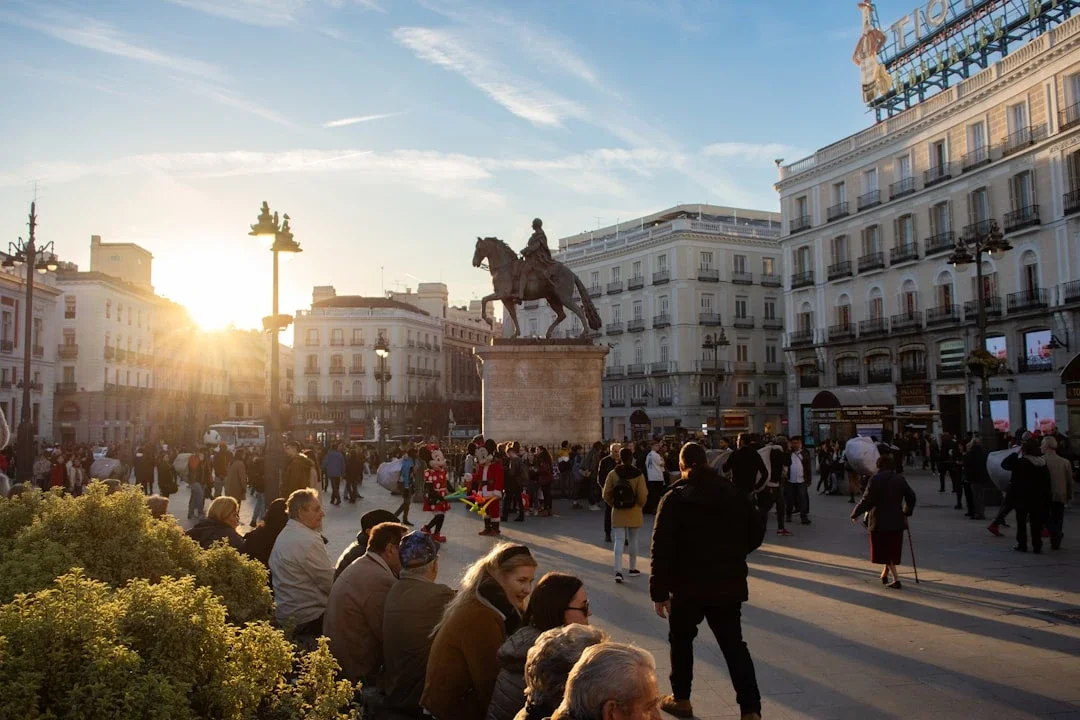
Madrid is the political, economic, and cultural capital of Spain, home to over 3.4 million people in a city that draws millions of international visitors every year. That tourist infrastructure means English is genuinely workable in central areas — but it's far from universal, and the moment you step off the main tourist circuit, expectations shift.
In the historic center (Sol, Gran Vía, the Retiro area) and around major attractions, hotel front desks, larger restaurant chains, and airport staff generally manage functional to strong English. Staff at contemporary cocktail bars and internationally oriented restaurants in neighborhoods like Malasaña or Chueca often speak it well. However, in traditional tabernas, local markets like Mercado de Maravillas, smaller family-run shops, and outer-city metro stations, English can disappear almost entirely. Taxi and ride-share drivers are a mixed bag — don't rely on English for directions in a cab.
At government offices, clinics, or any bureaucratic setting, assume Spanish is the working language and plan accordingly. Even in tourist zones, older Madrileños may simply not have had much exposure to English — patience and a few words of Spanish go a long way. Google Translate's camera mode is a reliable tool for reading menus and signs on the fly.
Learning even a handful of Spanish phrases earns immediate goodwill. Madrileños tend to speak fast — the Castilian accent drops letters in informal speech — so pronunciation matters less than effort. The 10 phrases below cover most practical situations a traveler will face day to day.
A note on pronunciation hints: the Spanish 'j' sounds like a hard English 'h', the 'v' sounds close to 'b', and the Castilian 'c' or 'z' before certain vowels produces a soft 'th' sound (so 'gracias' is roughly 'GRAH-thyahs' in Madrid, not 'GRAH-syahs' as in Latin America). Even an imperfect attempt in Spanish typically produces a warmer response than opening in English.
In the historic center (Sol, Gran Vía, the Retiro area) and around major attractions, hotel front desks, larger restaurant chains, and airport staff generally manage functional to strong English. Staff at contemporary cocktail bars and internationally oriented restaurants in neighborhoods like Malasaña or Chueca often speak it well. However, in traditional tabernas, local markets like Mercado de Maravillas, smaller family-run shops, and outer-city metro stations, English can disappear almost entirely. Taxi and ride-share drivers are a mixed bag — don't rely on English for directions in a cab.
At government offices, clinics, or any bureaucratic setting, assume Spanish is the working language and plan accordingly. Even in tourist zones, older Madrileños may simply not have had much exposure to English — patience and a few words of Spanish go a long way. Google Translate's camera mode is a reliable tool for reading menus and signs on the fly.
Learning even a handful of Spanish phrases earns immediate goodwill. Madrileños tend to speak fast — the Castilian accent drops letters in informal speech — so pronunciation matters less than effort. The 10 phrases below cover most practical situations a traveler will face day to day.
A note on pronunciation hints: the Spanish 'j' sounds like a hard English 'h', the 'v' sounds close to 'b', and the Castilian 'c' or 'z' before certain vowels produces a soft 'th' sound (so 'gracias' is roughly 'GRAH-thyahs' in Madrid, not 'GRAH-syahs' as in Latin America). Even an imperfect attempt in Spanish typically produces a warmer response than opening in English.