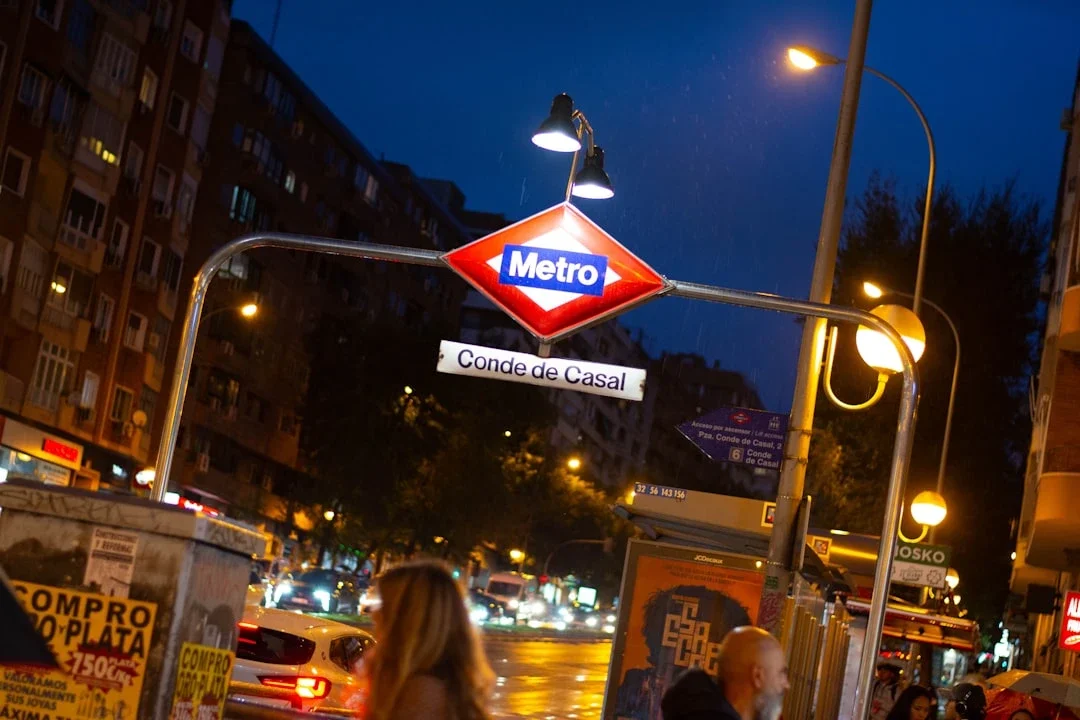
Madrid's metro first rolled in 1919, making it one of the oldest rapid transit networks in Europe. Today it spans thirteen heavy-rail lines plus three light-rail lines called Metro Ligero, covering the city centre and far into the wider metropolitan area. For most tourists, the metro is the fastest and most straightforward way to move between neighbourhoods like Sol, Malasaña, Lavapiés, and Salamanca — and to reach both Barajas Airport (Line 8) and the main intercity rail hubs.
The core ticketing tool is the rechargeable Tarjeta Multi, a contactless card available at any metro station vending machine for a small deposit. You load it with single-journey tickets or, if you're staying more than a few days, a Tourist Travel Pass (Abono Turístico) valid for 1, 2, 3, 4, 5, or 7 consecutive days of unlimited travel on metro, urban bus, and commuter rail (Cercanías) within the zones you select. Zone A covers the city centre and is sufficient for most holiday itineraries. Check current fares at metromadrid.es or crtm.es before your trip, as prices are set by the regional transport authority and subject to change.
The Empresa Municipal de Transportes (EMT) operates Madrid's urban bus network, which runs where the metro does not and keeps the city moving through the night. Regular buses run frequently throughout the day; the Búho (Owl) night bus network takes over after midnight, with routes radiating from Plaza de Cibeles. A single EMT journey uses the same Tarjeta Multi card — no need for a separate ticket. The three Metro Ligero tram lines serve specific outer districts (Pozuelo, Boadilla, Leganés) and are less relevant for central sightseeing, but integrate into the same zone-based fare system.
For real-time navigation, the official app is 'Metro de Madrid', which shows live departure times and maps. Google Maps and Citymapper both handle Madrid's network reliably and will suggest combined metro-bus routes. When planning, note that Line 1 (light blue) runs north–south through the centre, Line 6 (grey, the circular line) is useful for changing between radial lines, and Line 10 connects directly to the airport interchange at Nuevos Ministerios. Trains on main lines run roughly every 3–5 minutes at peak times and every 8–12 minutes late evenings.
A few practical tips: validate your Tarjeta Multi at every gate entry — there are no barriers on some bus routes, but inspectors do check. Keep a small cash buffer for the airport Line 8 supplement, which is charged on top of the standard fare for journeys to or from the Aeropuerto T1-T2-T3 and T4 stations. Cercanías commuter trains (operated by Renfe) are the best option for day trips to Alcalá de Henares or El Escorial and are included in the Tourist Travel Pass at the appropriate zone level.
The core ticketing tool is the rechargeable Tarjeta Multi, a contactless card available at any metro station vending machine for a small deposit. You load it with single-journey tickets or, if you're staying more than a few days, a Tourist Travel Pass (Abono Turístico) valid for 1, 2, 3, 4, 5, or 7 consecutive days of unlimited travel on metro, urban bus, and commuter rail (Cercanías) within the zones you select. Zone A covers the city centre and is sufficient for most holiday itineraries. Check current fares at metromadrid.es or crtm.es before your trip, as prices are set by the regional transport authority and subject to change.
The Empresa Municipal de Transportes (EMT) operates Madrid's urban bus network, which runs where the metro does not and keeps the city moving through the night. Regular buses run frequently throughout the day; the Búho (Owl) night bus network takes over after midnight, with routes radiating from Plaza de Cibeles. A single EMT journey uses the same Tarjeta Multi card — no need for a separate ticket. The three Metro Ligero tram lines serve specific outer districts (Pozuelo, Boadilla, Leganés) and are less relevant for central sightseeing, but integrate into the same zone-based fare system.
For real-time navigation, the official app is 'Metro de Madrid', which shows live departure times and maps. Google Maps and Citymapper both handle Madrid's network reliably and will suggest combined metro-bus routes. When planning, note that Line 1 (light blue) runs north–south through the centre, Line 6 (grey, the circular line) is useful for changing between radial lines, and Line 10 connects directly to the airport interchange at Nuevos Ministerios. Trains on main lines run roughly every 3–5 minutes at peak times and every 8–12 minutes late evenings.
A few practical tips: validate your Tarjeta Multi at every gate entry — there are no barriers on some bus routes, but inspectors do check. Keep a small cash buffer for the airport Line 8 supplement, which is charged on top of the standard fare for journeys to or from the Aeropuerto T1-T2-T3 and T4 stations. Cercanías commuter trains (operated by Renfe) are the best option for day trips to Alcalá de Henares or El Escorial and are included in the Tourist Travel Pass at the appropriate zone level.